Representative datasets, not generic benchmarks
Datasets are drawn from real media sector needs and tasks, so results reflect how a system performs on the kind of content and queries it will actually face.
For media organisations that need to know whether an AI system is actually ready to justify investment, AIME.Testbench links representative media datasets to evaluation infrastructure — automated scoring, structured human review, or both — so that claims about a system's performance are backed by evidence, not vendor demos.
AIME.Testbench does not evaluate architectures in the abstract. It reports on a particular reference implementation of the AIME media AI reference architecture, scored on the five dimensions that matter across the AIME program: cost, quality, latency, sovereignty, and trust.
Value proposition
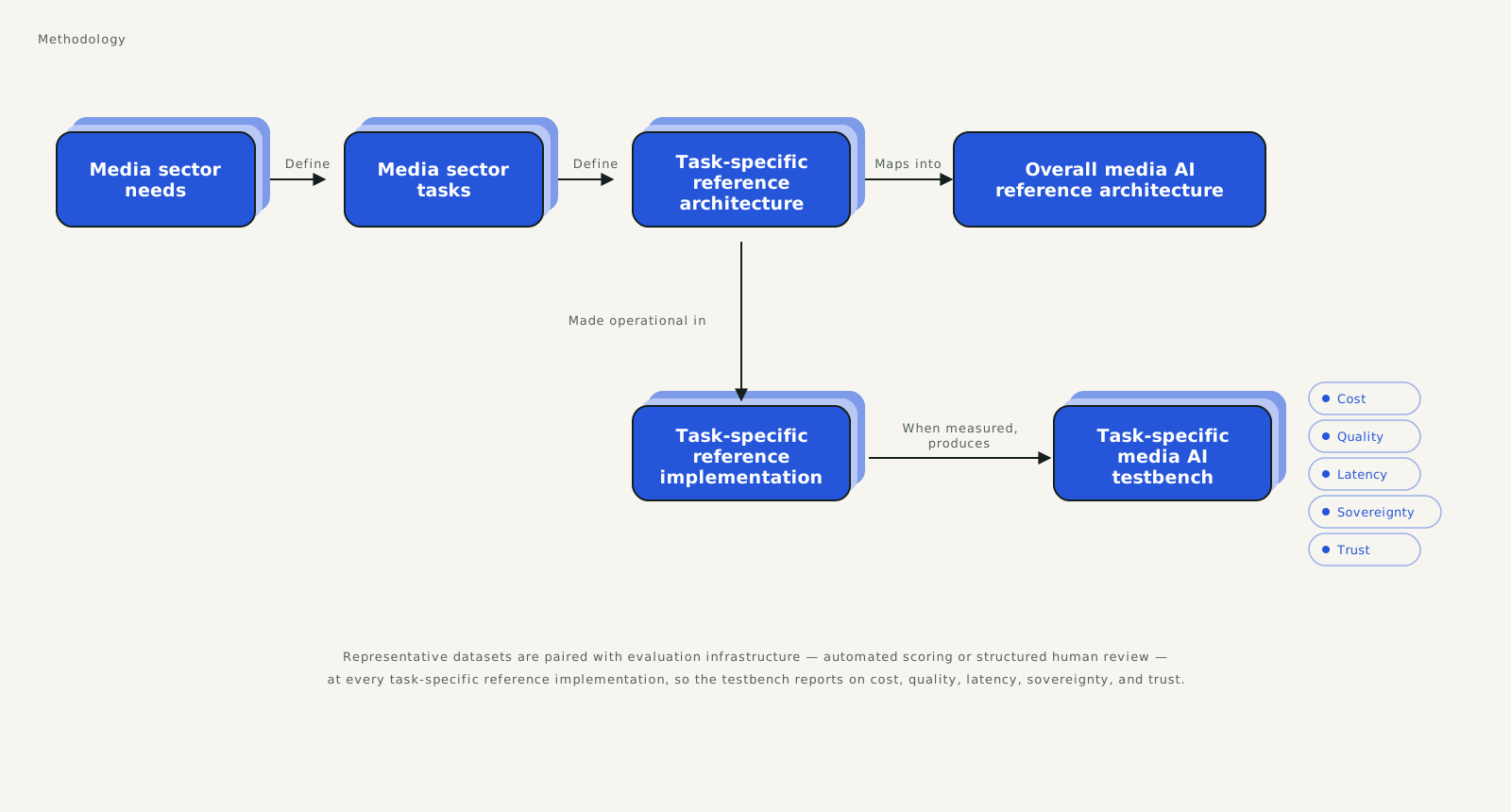
AIME.Testbench pairs representative datasets, drawn from real media sector needs and tasks, with evaluation infrastructure built for those tasks. Depending on what the task-specific reference implementation needs to prove, that infrastructure runs automated evaluation, structured human evaluation, or a combination of both.
The testbench is a reporting mechanism, not a standalone benchmark: it always measures a specific reference implementation of a task-specific reference architecture, so results are traceable back to a concrete, deployable system rather than an isolated model score.
Every measurement is expressed on the same five dimensions used across the AIME program — cost, quality, latency, sovereignty, and trust — so implementations can be compared on equal terms, whether they are retrieval, generation, or agentic systems.
The problem
Differentiators
Datasets are drawn from real media sector needs and tasks, so results reflect how a system performs on the kind of content and queries it will actually face.
Evaluation infrastructure runs automated scoring where it is reliable, and structured human review where editorial judgement is required, or both together.
Every result is tied to a specific reference implementation of a task-specific reference architecture, so it is traceable to a system an organisation could actually deploy.
Cost, quality, latency, sovereignty, and trust are measured together, so implementations can be compared on the same terms rather than on whichever metric a vendor chooses to highlight.
The same methodology, linking representative datasets to evaluation infrastructure, applies across retrieval, generation, verification, and agentic media tasks.
Organisations can compare emerging approaches before committing internal resources, production data, or audience trust, instead of testing alone.
Methodology
What gets measured
Inference and operating cost per task, so investment can be justified before production commitment.
Accuracy and usefulness on representative data, scored through automated metrics, human review, or both.
Response time under realistic load, so a system's speed is measured against actual workflow demands.
Data, model, and infrastructure control, so organisations know exactly what leaves their boundary and what stays.
Traceable, evidence-backed outputs with rights and compliance constraints enforced, not bolted on afterward.
Proof points
The media AI testbench is one of five active AIME research streams, built specifically around real media workflows and meaningful industry criteria.
The testbench methodology is designed alongside AIME.Architecture, so every task-specific reference architecture has a path to being measured, not just designed.
Target customer
Fit
Innovation, R&D, and technology leads at media companies and public broadcasters who need to compare retrieval, generation, or agentic AI systems on cost, quality, latency, sovereignty, and trust before committing production data, budget, or audience trust.
Next step
We can scope which representative datasets and evaluation infrastructure apply to your use case, and how results would be reported across cost, quality, latency, sovereignty, and trust. Scope and commercial packaging are confirmed per implementation context.