Grounded in sector needs, not technology first
The architecture is derived from media sector needs and tasks, so every component earns its place by solving a real editorial or archival problem.
For media organisations building an internal AI roadmap without wanting to design infrastructure from a blank page, AIME.Architecture is a shared media AI reference architecture: task-specific patterns for retrieval, generation, verification, and agentic media workflows, rolled up into one overall, EU-sovereign reference architecture.
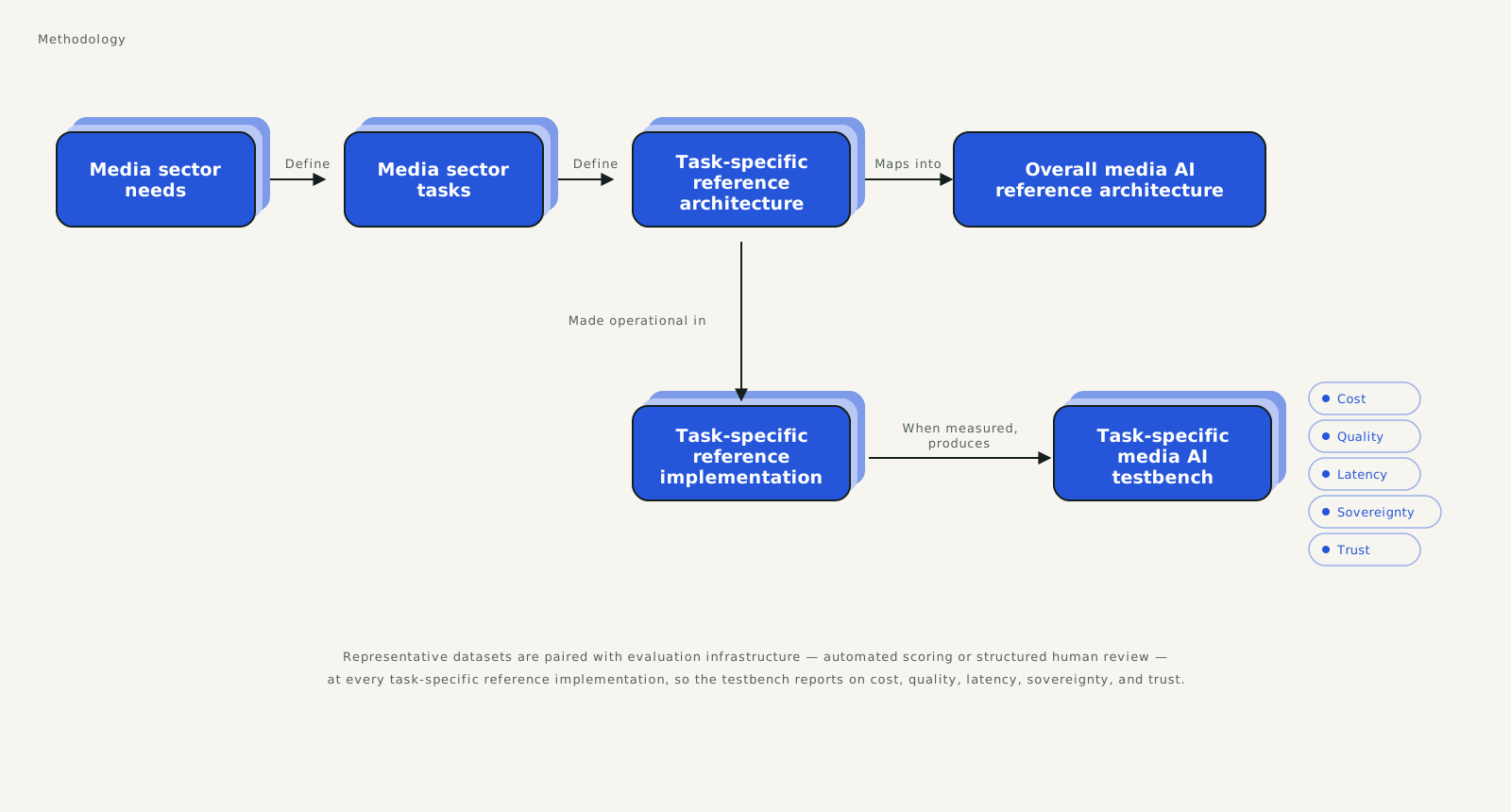
It is not an abstract diagram. Each task-specific reference architecture is made operational as a reference implementation, and every implementation is reported on by AIME.Testbench across cost, quality, latency, sovereignty, and trust — so the architecture stays accountable to evidence, not just intent.
Value proposition
AIME.Architecture starts from media sector needs and the concrete tasks media organisations actually run — archive retrieval, content transformation, disinformation defence, rights and value attribution. Each task defines its own task-specific reference architecture, and those task-specific architectures map into one overall media AI reference architecture that the whole program shares.
That overall architecture is EU sovereign by design: it assumes organisations keep control over their own data, models, and infrastructure choices, rather than inheriting an architecture dictated by whichever cloud AI vendor gets there first.
The architecture is made operational through task-specific reference implementations, and each implementation is in turn measured by AIME.Testbench. That closes the loop: architecture decisions are testable, not just documented.
The problem
Differentiators
The architecture is derived from media sector needs and tasks, so every component earns its place by solving a real editorial or archival problem.
Each media task gets its own task-specific reference architecture, and these map into one overall media AI reference architecture the whole program shares.
Data, model, and infrastructure control stay with the organisations that use the architecture, not with a third-party cloud AI platform.
Every task-specific reference architecture is built out into a working reference implementation, so architecture decisions can be run, not only reviewed.
AIME.Testbench measures each reference implementation on cost, quality, latency, sovereignty, and trust, so architecture choices are backed by evidence.
The architecture is co-developed and co-owned across the AIME program, so no single organisation carries the full cost of getting it right alone.
How it fits together
Proof points
Agentic retrieval, liquid media generation, disinformation defence, data value attribution, and the media AI testbench each contribute a task-specific reference architecture to the overall design.
The archive retrieval task-specific reference architecture has already been made operational as AIME.Retrieve, showing the path from architecture to deployable product.
Target customer
Fit
CTOs, architects, and innovation leads at media companies and public broadcasters who need a credible, sovereign starting point for their AI infrastructure roadmap, and want architecture decisions backed by a testbench rather than by vendor claims alone.
Next step
We can walk through which task-specific reference architectures apply to your organisation, and how a reference implementation would be measured by AIME.Testbench. Scope and commercial packaging are confirmed per implementation context.